

Food Security is a Global Challenge
Food security is vital to economic growth, stability and prosperity, yet rankings can mask a country's reliance on imported food.
What is food security?
Food security has traditionally meant food availability and people's access to it. Its definition has become more descriptive as its importance has grown, and the Food & Agriculture Organization (FAO), the US Department of Agriculture (USDA) and dozens of others now each have their own interpretation.
Definitions vary, but food security is achieved at the individual, household, national, regional and global levels when people have "physical and economic access to sufficient, safe and nutritious food" that meets their dietary needs and food preferences for an active, healthy life.
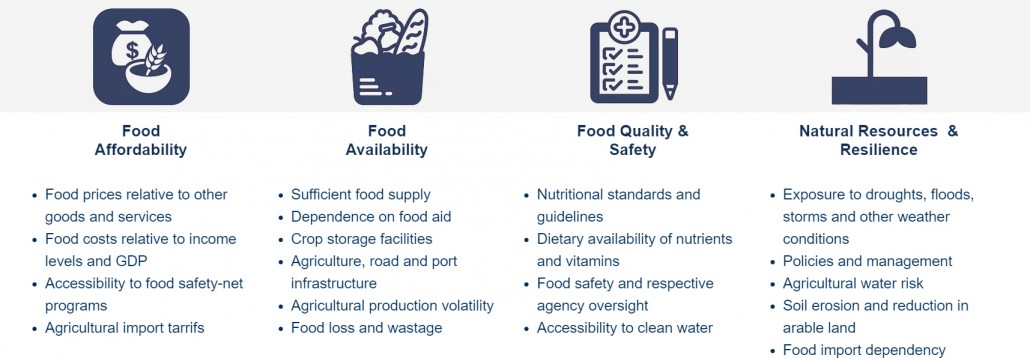
Despite the varying definitions, common indicators include food affordability, availability and accessibility, food quality and safety, and existing natural resources. The FAO and The Economist measure countries' food security against these indicators to varying degrees.
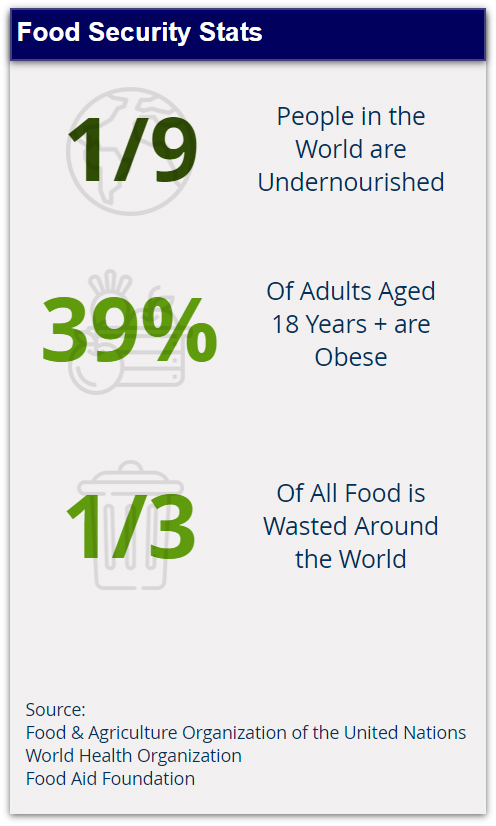
Why it matters
Food, along with water and air, is essential for human life. High food security is necessary for existence and is also vital to economic growth, stability and prosperity. Countries with poor food security often face chronic malnutrition, which limits the human capital development needed for economic growth.
Low food security places heavy strain on government budgets. Governments must spend heavily in the short term on social safety net programs and conditional cash transfers. They also become more reliant on food imports, which undermines long-term food self-sufficiency. The FAO has reported that high malnutrition rates can cause a GDP loss of as much as 4-5%.
Food security should be a priority for all countries, developing or developed. Low food security is often linked to poverty, but it also exists in affluent countries.
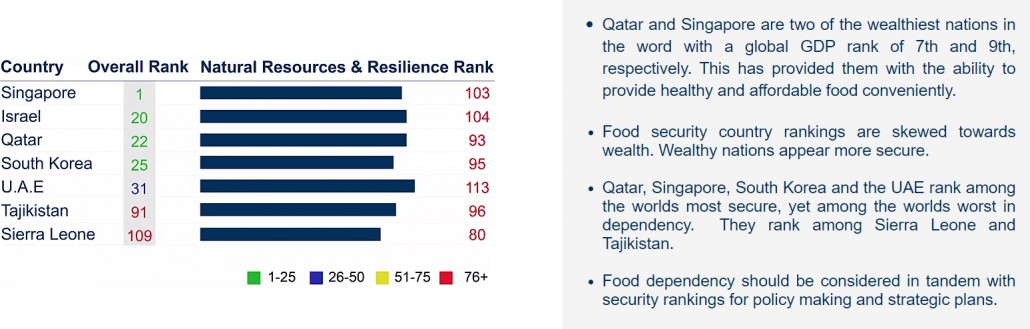
Rankings give a useful gauge of performance but have limits. Wealthy countries often rank highly because they have the infrastructure to provide accessible, healthy food. These rankings can mask weak natural resources and resilience, which measure import dependency only slightly. This raises the question of how a country can be food secure while depending heavily on others for its food supply.
Key food security indicators
Plantations International has developed its own measure, the Global Food Import Dependency Rankings, and recommends using it alongside other food security indices. The rankings are based on per-capita net food imports, which show how reliant each country is on other countries to feed its population.
Global Food Security Index Rankings 2023
The ranking graphic for 2023 is sourced to the Economist Intelligence Unit (Global Food Security Index) and Plantations International.
Related links
Farmers Are The Backbone of Society
Talk to our plantation team about developing, managing or owning a sustainable farm or orchard.