

Food Import Dependency
Food import dependency is an overlooked and growing risk. Plantations International's Global Food Import Dependency Rankings show how much countries rely on others to feed their populations.
An overlooked and growing risk
Food security is well documented and critical to a country's development. Its goal is for people to have physical and economic access to the food they need at all times.
The Economist Intelligence Unit's (EIU) Global Food Security Index is the global benchmark. Plantations International argues that it undervalues food import dependency. The world's wealthiest countries logically fare well in the rankings, because they have the capability and infrastructure to supply accessible food.
Those high rankings may hide import dependency. Imports can be disrupted by natural disasters, war or trade restrictions, which can greatly change a country's food security.
In response, Plantations International developed the Global Food Import Dependency Rankings (GFIDR) and recommends using them alongside other food security indices. The rankings are based on net food imports, which show how much countries rely on others to feed their populations. Highly import-dependent countries should review their food policies and strategies to reduce vulnerability to disruption.
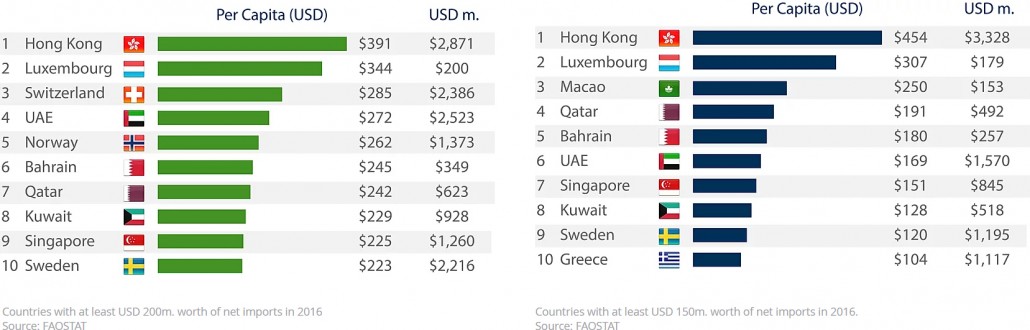
Global Food Import Dependency Rankings 2019 (GFIDR)
The rankings tables cover fruit and vegetables, and meat, showing each country's GFIDR score alongside its import value. Source: Plantations International.
Fruit and vegetables: key findings
- Seven of the world's top 10 fruit and vegetable import-reliant countries are among the EIU's most food-secure countries.
- Singapore (1st), Switzerland (7th), and Norway and Sweden (12th, tied) rank among the most food secure, yet together import almost USD 9 billion of produce per year.
- The world imports over twice as much fruit and vegetables as meat, a difference of USD 100 billion.
- By value, prepared and preserved fruits, bananas, and preserved and frozen vegetables dominate global imports.
- Potatoes, a leading staple, are increasingly imported and are the fourth most-imported fruit or vegetable.
Meat and livestock: key findings
- Eight of the world's top 10 meat import-reliant countries are also among the most reliant on fruit and vegetable imports.
- Beef (35%) and pork (33%) are the most-imported meats by share of total meat import value, including sausages and other preparations such as chopped and minced meat.
- On a category basis, the top 10 import-dependent countries spend 25% less per capita on meat than on fruit and vegetables.
- By individual product, beef, pork and chicken imports are each over twice the size of the most-imported fruit or vegetable. Beef and pork each exceed USD 40 billion per year, and chicken exceeds USD 30 billion per year.
Related links
Farmers Are The Backbone of Society
Talk to our plantation team about developing, managing or owning a sustainable farm or orchard.